
Have you ever spent more time setting up a productivity tool than actually doing the work? You’re not alone! Don’t worry, let me share the simple yet effective productivity hack that I use every single day.
The two steps
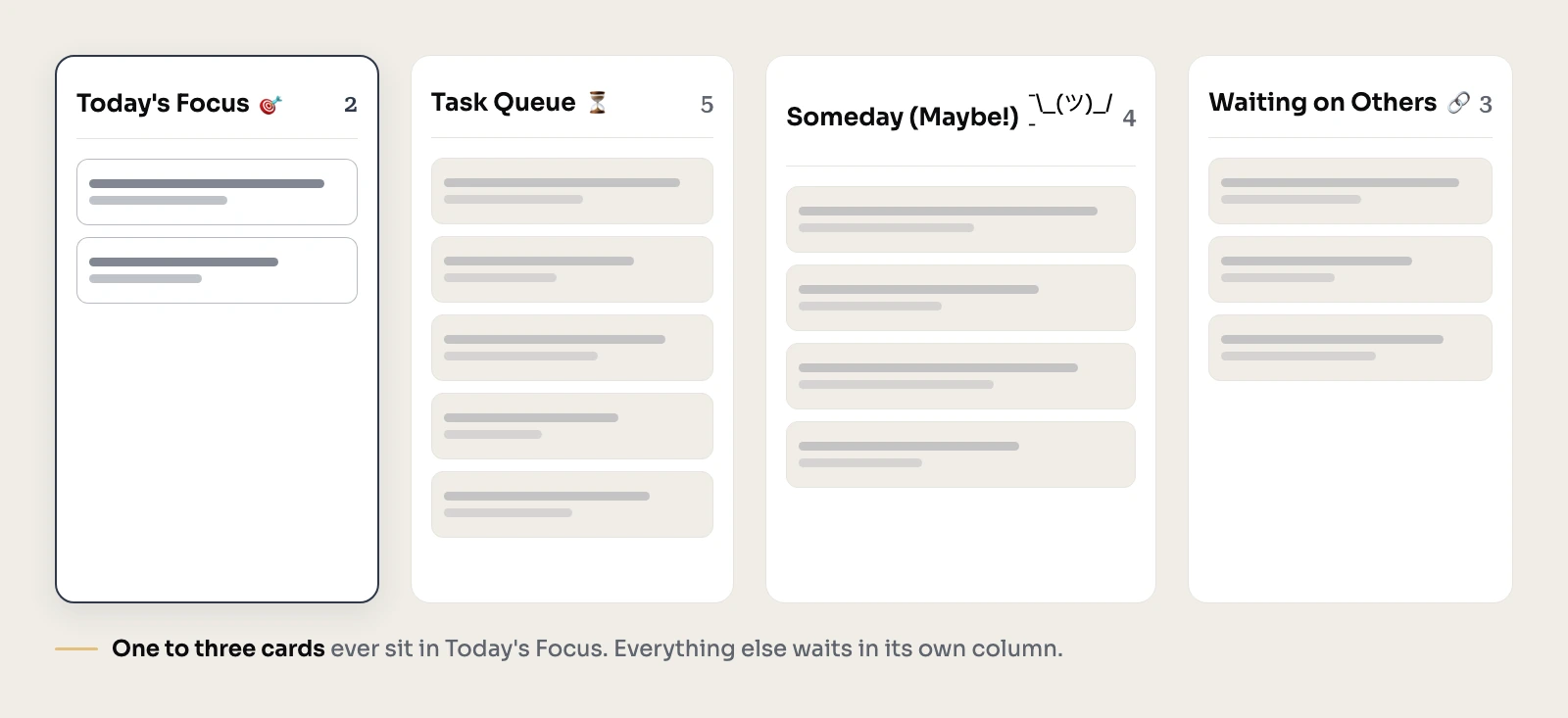
Here is my simple, daily Kanban setup (Use Todoist or Google Sheet with Tabs):
-
The Night Before: Pick 1 to 3 “needle-moving” tasks (using the Pareto Principle, i.e. 80/20 rule). I ask myself one question. Which task is the most important? Which one will make the biggest difference? That task goes into Today’s Focus. Once it is done, the other jobs usually get easier.
Three is the maximum and most days I pick one. If your list is longer than that, it is not a plan any more. Everything else goes to Task Queue, Someday (Maybe!) or Waiting on Others. It is out of your head, and it is still not lost.
-
The Morning Of: Focus entirely on that primary task until it’s done. Email and WhatsApp can wait. I first wrote this down in my 2014 list of productivity tips, and it is still the hardest part. The first hour is the only hour nobody else has booked. Open the inbox and you are working on somebody else’s list.
If the task is too big to finish in one sitting, it was never one task. Split it the night before. Not at 9 in the morning, when you are already looking for a reason to start something easier.
How to decide which task to work on
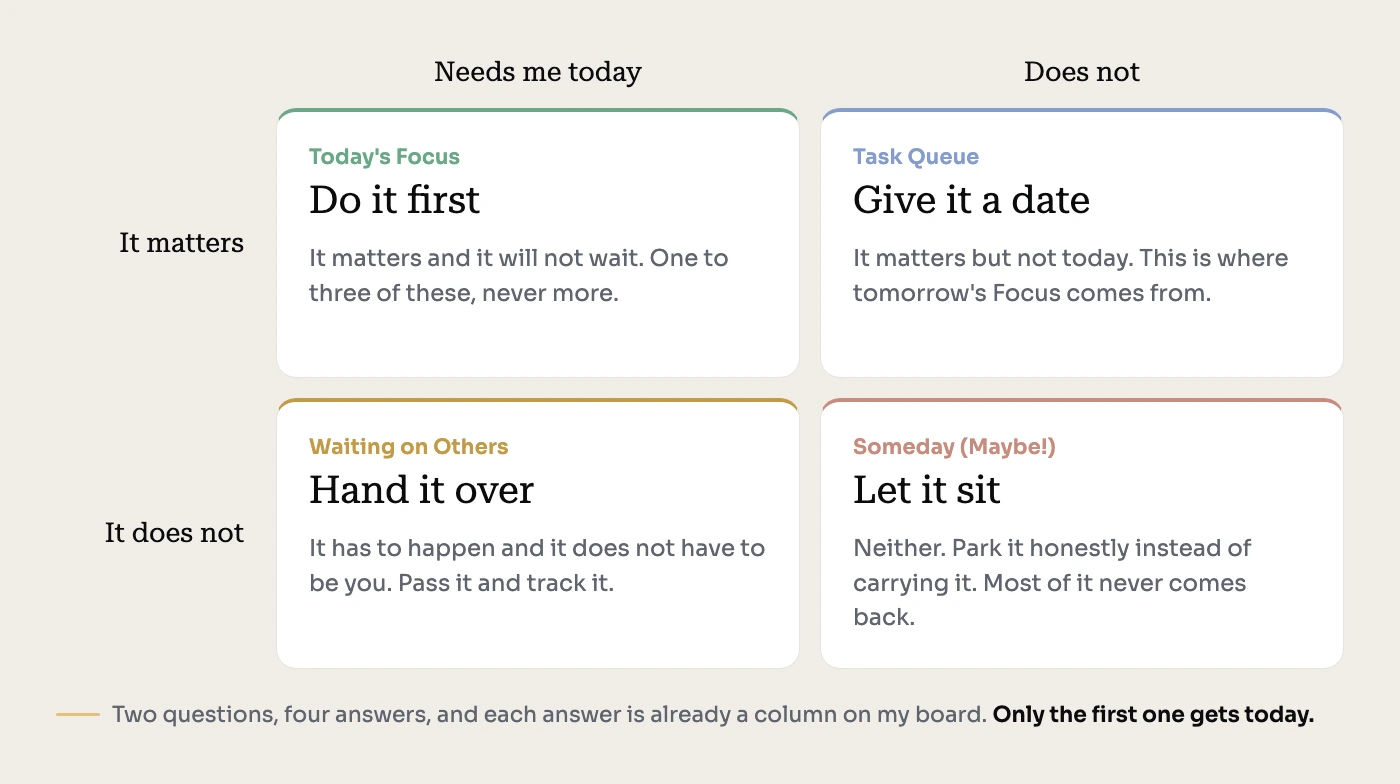
So which one earns Today’s Focus? The trap is that urgent and important feel identical at 9 in the morning. A message asking for something by lunch is urgent. The proposal that decides the next three months is important. Urgent things make noise. Important things wait quietly. So most of us spend the day answering whoever made the most noise.
Not everything is urgent, even when it feels urgent. I learned that years ago, and I use it more today than I did then. So I ask two questions before I rank anything. Does this matter? And does it need me today? The four answers are the four columns on my board.
Why it works
Once you start following this, you will achieve more than you planned, because when we focus on one task, the chances of procrastination are very low. Also, once we finish that important task, you are likely to continue and finish more tasks.
This method works because once you finish the important task of the day, you get a dopamine boost and feel satisfied. There will be no regret at the end of the day, and you can enjoy your family time or personal time once working hours are over.
Don’t forget to share your thoughts and let me know if you like such productivity and motivation tips.
Comments
No comments yet. Yours can be the first.